
The Cycle of Division and Reunification
The Romance of the Three KingdomsThis flow traces the novel’s historical pattern of empire, fragmentation, and reunification, placing each victory within a larger cycle.
increasing Bearing strength in each event
 decreasing
Bearing strength in each eventdecreasingThe Ancient Pattern
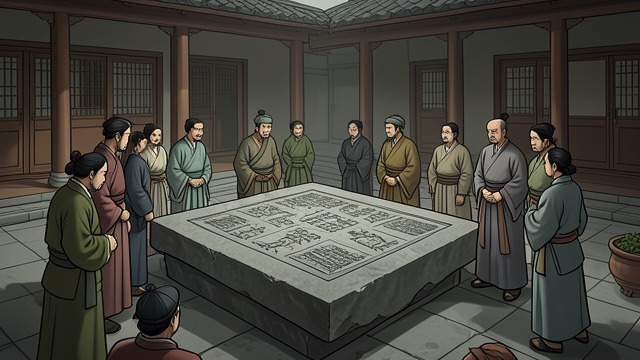
Unity Gives Way to Division
Dynasties Rise and Fall
The narrative recalls earlier dynasties whose unity gave way to rivalry, conquest, and new political orders.
A Historical Lens
The Han’s collapse is presented not as a unique accident but as part of a recurring pattern. Each restoration carries the possibility of its own eventual failure.
The Han’s Four Centuries
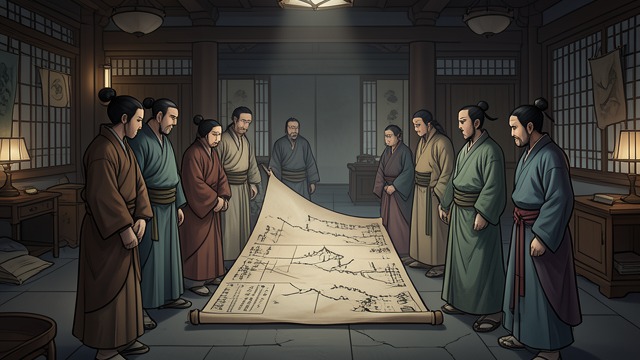
A Long Rule Becomes a Standard
Stability and Record
The Han’s lengthy rule gives it an enduring place in Chinese historical memory and a model of dynastic order.
The Weight of Collapse
Because the dynasty represents continuity, its late breakdown becomes a warning about ambition, corruption, and the loss of public trust.
The Three Kingdoms Divide the Realm
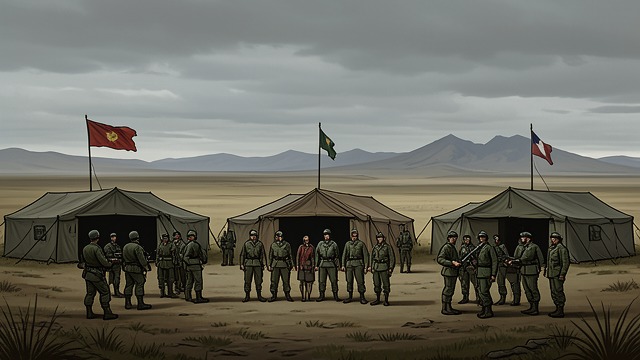
Rival States Take Shape
Three Centers
Cao Cao, Xuande, and Sun Quan establish competing bases in the north, west, and south.
A Temporary Balance
The kingdoms’ alliances and wars prevent any one ruler from quickly restoring unity. Division becomes the political condition in which every local victory must be judged.
Shu and Wei Replaced
The Names Change
Shu Falls
Deng Ai’s invasion ends Shu, while Jiang Wei’s last effort fails to reverse the conquest.
Jin Replaces Wei
Sima Yan takes the Wei throne and establishes Jin. The ruling houses change, but the historical problem of reunification remains unresolved until Wu falls.
One Empire Again
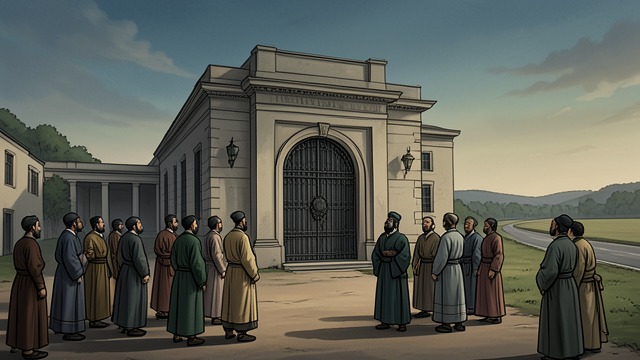
The Cycle Closes
Wu Surrenders
Jin’s armies take the Wu capital, and Sun Hao submits. The three kingdoms become one under Sima Yan.
A New Beginning
The reunification answers the immediate political division, but the novel’s closing reflections insist that order and chaos remain linked. Unity is an achievement, not a permanent condition.
In the opening historical frame
From the Han founding to the late Eastern Han
After the Han’s collapse
AD 263–265
AD 280
